CERN LHC produces first 7TeV collisions during RAL Tier-1 computing open day

Tuesday 30 March 2010

Keith Mason
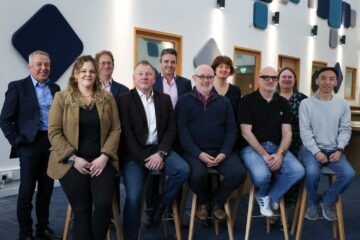
Keith Mason talks at e-Science data centre open day 2010

Today the CERN LHC collided its proton beams at an energy of 7TeV for the first time, while the RAL Tier-1 data centre was holding its open day.

Just before noon today, UK time, the two proton beams in the LHC at CERN collided for the first time at the record breaking energy of 7TeV. The four experiments on the LHC, Atlas, Alice, CMS and LHCb, all recorded collision events which were sent to the Tier-1 data centres around the world for analysis. There are 11 Tier-1 data centres which receive data from the Tier-0 centre at CERN and store it, so that it can be analysed either at the Tier-1 sites, or at Tier-2 sites in universities. The STFC RAL e-Science data centre is the Tier-1 data centre which serves data to the UK and Ireland.

The Tier-1 data centre is housed in the new e-Science building which has been occupied since May last year, but held its official opening today, to promote its services to other science facilities in the UK. The day started at 2pm following the CERN first data arriving, when the data rates had ramped up to accept the 100,000 events per hour being detected by each experiment on the LHC. The STFC Director of e-Science, Neil Geddes, opened the event, followed by presentations from the teams who provide the services which keep the data centre functioning; hardware management, grid services, large scale data storage, databases and the production team who hold it all together.

After the technical talks, the official opening of the data centre was lead by Prof Keith Mason the STFC chief executive, followed by Andrew Taylor, the STFC Director of Facilities, and Prof David Britton, the GridPP project leader.

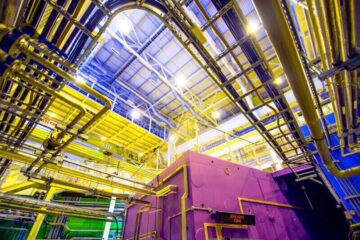
The data centre machine room consists of 892 square metres of space, housing 80 racks of computers, a 6 petabyte tape robot, four 750kW chillers, four 2350kW transformers and a 120kW UPS for critical services (backed up with a diesel generator). The Tier-1 computer service operates 5000 processing cores although the data centre has a further 20,000 for other services.

The data centre currently supports the particle physics community through the LHC Tier-1, but it also supports the entire UK research community as part of the NGS which is accessible to all UK researchers. A small percentage of the Tier-1 computing resource has been made available to the biosciences and earth sciences research communities over the last few years through the EGEE European projects, in order to demonstrate the usefulness of computing grid technologies in their disciplines. In addition, the data centre operates cluster computers as national resources for several disciplines including computational chemistry and laser physics, as well as housing the Petabyte Data Store which is used by other research councils and universities to provide on-line storage of data.

STFC e-Science would like to attract further compute clusters and the data support for other UK academic research communities so that all can benefit from the higher quality of service that can be provided, and reduced costs, as the service volume increases.

Contact


© 2013 Science and Technology Facilities Council - All Rights Reserved.