Solar and Heliospheric Observatory (SOHO)
SOHO was launched on board an Atlas 2AS rocket from Cape Canaveral, Florida on 2nd December 1995. This European Space Agency ( ESA (link opens in a new window)) cornerstone mission is a joint venture with the National Aeronautics and Space Administration (NASA (link opens in a new window)), to study the Sun, from its deep interior, through its atmosphere, out to the heliosphere, including the solar wind and its interaction with the interstellar breeze.
On board the SOHO (link opens in a new window)spacecraft is RAL Space's Coronal Diagnostic Spectrometer (CDS (link opens in a new window)). This is the first instrument to probe the solar atmosphere using combined high resolution (spatial, spectral and temporal) observations of the Sun at extreme ultraviolet wavelengths over an extended period of time. These observations are being used to derive characteristics of the plasmas in the solar atmosphere, such as density, temperature, flow velocities and element abundances. Analyses of this kind will allow us to take the Sun's atmosphere "to pieces" in an effort to understand how it works - essential if we are to understand its influence on the Earth environment.
The CDS instrument, a double spectrometer, was developed and constructed by an international team led by the RAL Space at STFC's (link opens in a new window) Rutherford Appleton Laboratory (RAL).
As well as providing the overall management of the project, RAL designed and built the structure, including the scan mirror mechanism, slit mechanism, pointing mechanism, telescope doors, the wiring harness, the mechanism control unit, and the thermal control system.
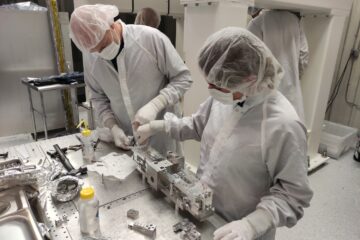
RAL Space were also responsible for the thermal and mechanical design and testing, together with the assembly, integration and test, contamination control and product assurance. The team co-ordinated and wrote much of the science analysis software and managed the ground test system, in the pre-flight phase. In flight, RAL Space are responsible for operating the CDS and managing the CDS operations facilities located at the Goddard Space Flight Center (GSFC (link opens in a new window)) and at RAL.
The CDS project involves many individuals from technicians and engineers to solar physicists, from design staff to optics specialists, from managers to computer hardware and software experts, from students to professors. Without their expertise and dedication major scientific space instruments like CDS would not be possible.
Other major participants in the project are:
© 2012 Science and Technology Facilities Council - All Rights
Reserved.