Robotics
One of the RAL Space outreach rovers
The Robotics Group at RAL Space is developing autonomous robotic platforms that can be used both for space and terrestrial applications.
The Group was formed to exploit existing in-house expertise in electro-mechanical systems, sensors and autonomous systems. Research and development is currently underway as to how such devices may be used, not just in the space arena for the exploration of the Moon and Mars, but also importantly, for the large number of potential applications here on Earth.
The Group has a very active Outreach programme, providing hands-on experience of operating rover platforms for youngsters, supporting school visits on-site at RAL, visiting local schools and youth groups such as the Cub-Scouts, and demonstrating the rovers at external events such as at the Science Museum, London in August 2011, during their "Spend your Summer in Space" exhibition and the upcoming Big Bang Fair (link opens in a new window)at the NEC in March 2012.
Current Rovers
RAL Rover
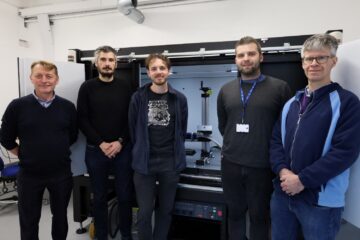
Wayne Tubby, Christina McQuirk and Aron Kisdi with RAL Rover at the Science Museum
(Credit: Science Museum, London)
RAL Rover, is a highly agile robot platform that can carry a variety of sensors, such as stereo cameras, to provide the sensory inputs for the autonomous software. It is a six-wheeled rover, similar to the one that ESA is developing under the ExoMars programme. In addition to its normal ‘rolling’ movement, RAL Rover is able to lock its wheels and raise or lower its legs independently, thus allowing it to ‘walk’ or climb over hazards.
Development activity is principally aimed at optimising the various locomotive modes, with the Rover eventually being able to autonomously decide which mode to use, in response to its perception of the hazards in its immediate locality.
Rimmer
Rimmer Rover, with the Robotics team, just before field trials commenced.
Rimmer is a quad-bike-sized rover designed specifically to participate in the ESA StarTiger long distance autonomous navigation project known as ‘Seeker’. Rimmer is not designed to be a ‘space’ rover but rather a rugged terrestrial rover capable of traversing rough terrain here on Earth in order to demonstrate the sensors and software for the Seeker project.
Rimmer’s major task on Seeker will be to travel 2km per day over a Mars-like terrain for 3 consecutive days without any intervention by a human operator, using just a stereo camera and some very clever software to find his way around various hazards including large rocks and steep slopes, noting and logging the position of any scientifically interesting rocks or features on the way. His high-capacity batteries will allow him to travel for at least 12 hours without being recharged.
More Project Information:
ESA StarTiger - Seeker
© 2012 Science and Technology Facilities Council - All Rights
Reserved.