Cosmic rays detected deep underground reveal secrets of the upper atmosphere
Cosmic-rays detected half a mile underground in a disused U.S. iron-mine can be used to detect major weather events occurring 20 miles up in the Earth's upper atmosphere, a new study has revealed.
Published in the journal Geophysical Research Letters and led by scientists from the UK's National Centre for Atmospheric Science (NCAS) and the Science and Technology Facilities Council (STFC), this remarkable study shows how the number of high-energy cosmic-rays reaching a detector deep underground, closely matches temperature measurements in the upper atmosphere (known as the stratosphere).
For the first time, scientists have shown how this relationship can be used to identify weather events that occur very suddenly in the stratosphere during the Northern Hemisphere winter. These events can have a significant effect on the severity of winters we experience, and also on the amount of ozone over the poles - being able to identify them and understand their frequency is crucial for informing our current climate and weather-forecasting models to improve predictions.
Working in collaboration with a major U.S.-led particle physics experiment called MINOS (managed by the U.S. Department of Energy's Fermi National Accelerator Laboratory), the scientists analysed a four-year record of cosmic-ray data detected in a disused iron-mine in the U.S. state of Minnesota.
What they observed was a strikingly close relationship between the cosmic-rays and stratospheric temperature - this they could understand: the cosmic-rays, known as muons are produced following the decay of other cosmic rays, known as mesons. Increasing the temperature of the atmosphere expands the atmosphere so that fewer mesons are destroyed on impact with air, leaving more to decay naturally to muons.
Consequently, if temperature increases so does the number of muons detected.
What did surprise the scientists, however, were the intermittent and sudden increases observed in the levels of muons during the winter months. These jumps in the data occurred over just a few days. On investigation, they found these changes coincided with very sudden increases in the temperature of the stratosphere (by up to 40 oC in places!). Looking more closely at supporting meteorological data, they realised they were observing a major weather event, known as a Sudden Stratospheric Warming. On average, these occur every other year and are notoriously unpredictable. This study has shown, for the first time, that cosmic-ray data can be used effectively to identify these events.
Lead scientist for the National Centre for Atmospheric Science, Dr Scott Osprey said: "Up until now we have relied on weather balloons and satellite data to provide information about these major weather events. Now we can potentially use records of cosmic-ray data dating back 50 years to give us a pretty accurate idea of what was happening to the temperature in the stratosphere over this time. Looking forward, data being collected by other large underground detectors around the world, can also be used to study this phenomenon."
Dr Giles Barr, co-author of the study from the University of Oxford added: "It's fun sitting half a mile underground doing particle physics. It's even better to know that from down there, we can also monitor a part of the atmosphere that is otherwise quite tricky to measure".
Interestingly, the muon cosmic-ray dataset used in this study was collected as a by-product of the MINOS experiment, which is designed to investigate properties of neutrinos, but which also measures muons originating high up in the atmosphere, as background noise in the detector. Having access to these data has led to the production of a valuable dataset of benefit to climate researchers.
Professor Jenny Thomas, deputy spokesperson for MINOS from University College London said "The question we set out to answer at MINOS is to do with the basic properties of fundamental particles called neutrinos which is a crucial ingredient in our current model of the Universe, but as is often the way, by keeping an open mind about the data collected, the science team has been able to find another, unanticipated benefit that aids our understanding of weather and climate phenomena."
Dr Osprey commented: "This study is a great example of what can be done through international partnerships and cross-disciplinary research. One can only guess what other secrets are waiting to be revealed."
Editors Notes
This press release has been jointly issued by the UK's National Centre for Atmospheric Science and the Science and Technology Facilities Council. The data from this study is owned by the MINOS collaboration/Fermilab in the US.
Movies
Images of the MINOS experiment
Image of the Soudan Mine
Contacts
-
Dr Louisa Watts
National Centre for Atmospheric Science
Science Communications Manager
Tel: +44 (0)1793 411 609
Mob: +44 (0)778 621 4886
-
Julia Maddock
Science and Technology Facilities Council
Media Relations Manager
Tel: + 44 (0)1793 442 094
Mob: +44 (0)7901 514 975
-
Kurt Riesselmann
Fermilab, USA
Head of Office of Public Information
Tel: (+1) 630 840 3351
Available for Interview
-
Dr Scott Osprey
Lead scientist of this study and climate scientist at the National Centre for Atmospheric Science (NCAS)
Tel: +44 (0)1865 272 095
To set up an interview with Dr Osprey, please contact Dr Louisa Watts (Mob: +44 (0)778 621 4886).
-
Prof Jenny Thomas
Senior scientist at University College London and Deputy spokesperson for the MINOS experiment
Tel: +44 (0)207 679 7159
Mob: +44 (0)7941 247 596
Prof Thomas is funded by the STFC for her involvement in the MINOS experiment.
-
Dr Giles Barr
Co-author on the paper and lecturer at the Department of Physics, University of Oxford
Contact by email only as travelling in Japan
Dr Barr is funded by the STFC for his involvement in the MINOS experiment
-
Prof Alec Habig
Senior scientist working on MINOS project, based at University of Minnesota, Duluth, USA
Tel: +1 218 726 7214
-
Dr Robert Plunkett
Senior scientist within Fermilab (USA) working on the MINOS project
Please contact Kurt Riesselman (Fermilab) above.
Geophysical Research Letters (GRL) paper
The Geophysical Research Letters (GRL) paper is referenced:
Sudden stratospheric warmings seen in MINOS deep underground muon data
Osprey, S.M. et al., Geophys. Res. Lett., doi:10.1029/2008GL036359, in press.
The paper is available online (link opens in a new window) at the American Geophysical Union (AGU) website. Please note, that if you are not already registered with this journal then you will need to do so to download the paper. To register, please either send an email, telephone (+1 202 777 7507) or register online (link opens in a new window).
Please note that according to GRL's publication's policy, once a manuscript has been placed online as a Paper-in-Press (PIP), then results from the paper can be publicised.
The National Centre for Atmospheric Science (NCAS)
The National Centre for Atmospheric Science (link opens in a new window) (NCAS) is a world leader in atmospheric science. With an annual budget of £9M, NCAS carries out research programmes in climate change science, atmospheric composition (including air quality), weather (including hazardous weather) and state-of-the-art technologies for observing and modelling the atmosphere (including a world-leading research aircraft). We have over 100 research scientists, including UK and world experts to work on our research programmes and provide support to the academic community. These programmes are distributed throughout the UK, at 15 UK universities and research institutes. NCAS is a research centre of the Natural Environment Research Council with its headquarters at the University of Leeds.
Dr Scott Osprey, the lead scientist and lead author for this study, is funded by the National Centre for Atmospheric Science, through its Climate Research programme. He is based at the University of Oxford.
Both Dr Giles Barr and Professor Jenny Thomas receive funding from the STFC for their participation in the MINOS Experiment.
The "Main Injector Neutrino Oscillation Search" (MINOS)
The Main Injector Neutrino Oscillation Search (link opens in a new window)(MINOS) experiment is a long-baseline neutrino experiment designed to observe the phenomena of neutrino oscillations, an effect which is related to neutrino mass. MINOS uses two detectors, one located at Fermilab, at the source of the neutrinos, and the other located 450 miles away, in northern Minnesota, at the Soudan Underground Mine State Park in Tower-Soudan.
The MINOS experiment includes about 130 scientists, engineers, technical specialists and students from 28 institutions in several countries, including Brazil, Greece, Poland, the United Kingdom and the United States. The institutions include 24 universities as well as 4 national laboratories, including the Rutherford Appleton Laboratory in the UK. The U.S. Department of Energy provides the major share of the funding, with additional funding from the U.S. National Science Foundation and from the United Kingdom's Science and Technology Facilities Council.
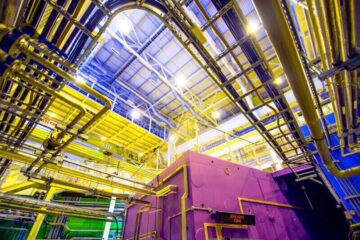
The Fermilab side of the MINOS experiment consists of a beam line in a 4,000-foot-long tunnel pointing from Fermilab to Soudan. The tunnel holds the carbon target and beam focusing elements that generate the neutrinos from protons accelerated by Fermilab's Main Injector accelerator. A neutrino detector, the MINOS "near detector" located 350 feet below the surface of the Fermilab site, measures the composition and intensity of the neutrino beam as it leaves the lab. The Soudan (link opens in a new window) side of the experiment features a huge 6,000-ton particle detector that measures the properties of the neutrinos after their 450-mile trip to northern Minnesota. The cavern housing the detector is located half a mile underground in a former iron mine.
Fermi National Accelerator Laboratory (Fermilab)
Fermi National Accelerator Laboratory (link opens in a new window)(Fermilab) is a Department of Energy national laboratory operated under contract by the Fermi Research Alliance, LLC. The DOE Office of Science is the single largest supporter of basic research in the physical sciences in the nation and helps ensure U.S. world leadership across a broad range of scientific disciplines. Founded in 1967, Fermilab is a Department of Energy National Laboratory in Batavia, Illinois, about 40 miles west of Chicago. Fermilab operates the world's highest-energy particle accelerator, the Tevatron, on its 6,800-acre campus. About 2,500 physicists from universities and laboratories around the world do physics experiments using Fermilab's accelerators to discover what the universe is made of and how it works. Discoveries at Fermilab have resulted in remarkable new insights into the nature of the world around us.
Acknowledgements
This work was supported by the U.S. Department of Energy, the National Centre for Atmospheric Science (NCAS), the UK Science and Technology Facilities Council, the US National Science Foundation, the State and University of Minnesota, the Universities of Athens, Greece and Brazil's FAPSEP and CNPq. NCAS British Atmospheric Data Centre and the European Centre for Medium range Weather Forecasting provided environmental data for this project. Acknowledgements go to the Minnesota Department of Natural Resources, the crew of the Soudan Underground Laboratory, and the staff of Fermilab for their contribution to this study.
About STFC
Page last updated: 21 January 2009
by Julia Maddock