This page has moved from: http:/www.stfc.ac.uk/PMC/PRel/STFC/SRS.aspx. Please update your bookmark - thank you.

After two million hours of science a British world first bids farewell

Cleaner fuel, safer aircraft and new medicines, not to mention a Nobel prize, great tasting chocolate and iPods - all of these things have been influenced or made possible by world leading scientific research carried out on the Synchrotron Radiation Source (link opens in a new window) (SRS which is now closed) at the Science and Technology Facilities Council’s (STFC) Daresbury Laboratory in Warrington, which closes today (4th August 2008) after 28 years of operation and two million hours of science.

Arial view of Daresbury Laboratory
Credit: STFC Daresbury Laboratory

The SRS was a genuine world first, pioneering the way for the development of 60 similar machines around the world. Since 1980 it has played a key role in enabling and performing cutting edge research in many areas of UK and international science. The SRS produces beams of light so intense that they can reveal the structure of atoms and molecules inside materials. It produces this light by generating beams of high energy electrons travelling close to the speed of light. Over the last 28 years, synchrotron light has supported cutting-edge research in physics, chemistry and materials science and opened up many new areas of research in fields such as medicine, geological and environmental studies, structural genomics and archaeology.

The SRS has improved the quality of our lives in a remarkable number of ways that we take for granted. As examples, it has helped develop new medicines by studying the atomic structure of proteins; it has enabled the production of new materials for use in electronics and clothing; it has led to the development of new detergents. It has even played a role in improving the taste of chocolate and the safety of aircraft by looking at the crystal formations in chocolate and metal. Even the huge magnetic memory of the iPod is due to research carried out on the SRS. However, its most famous achievement by far is the critical role it played towards a share of a Nobel prize in chemistry to Sir John Walker in 1997, for solving a structure of an enzyme that opened the way for new insights into metabolic and regenerative disease.

During its lifetime, the SRS has collaborated with almost every country active in scientific research. It has hosted over 11,000 users from academia, government laboratories and industry worldwide, leading to the publication of more than 5000 research papers in leading journals. It has resulted in numerous patents and has solved over 1200 protein structures.

The formal closing ceremony, which takes place at STFC Daresbury Laboratory today, will be attended by leading figures from the machine’s history, including Professor Ian Munro, one of the original founders of the concept that synchrotron light could be used to perform science, and who was responsible for the plans for building the SRS and its operation.

Of the closure Ian said: “It is with immense pride and a great sense of achievement that I look back and contemplate the success of the SRS not to mention the teamwork and expertise at Daresbury that went into building, maintaining and operating this great British scientific facility. Of course this is a sad occasion for me, but since the day the SRS was first switched on it has always been subject to a fixed life span and this day was always going to come. The SRS has kept the UK at the forefront of scientific research and now passes its baton onto the new Diamond Light Source in Oxfordshire, the UK’s direct successor to the SRS. Diamond will continue to build on the positive legacy of Synchrotron light research in this country.”

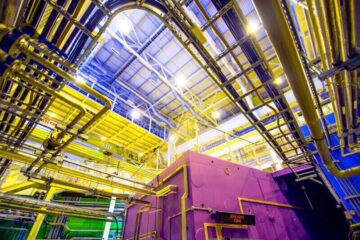
SRS Daresbury Laboratory
Credit: STFC Daresbury Laboratory

Professor Colin Whitehouse, STFC’s Deputy Chief Executive and Director of Campus Strategy said: “The SRS was one of the world’s most pioneering scientific inventions and Daresbury can be very proud of its outstanding achievements.” He added: “Though the SRS has gone, Daresbury Laboratory is growing. It is part of a burgeoning national Science and Innovation Campus and the home of the Cockcroft Institute, a national centre for Accelerator Science and Technology, amongst other world-class research facilities. The Government’s recent announcement of £65M earmarked for Daresbury will provide two new additional Science and Technology Gateway Centres for computational science and engineering and detector systems. Daresbury will also continue its state-of-the-art accelerator science and technology research programmes based on the continuing operation of the Energy Recovery Linac Prototype known as ALICE, a technology which already offers important prospects for new cancer treatments.”

STFC recently announced the launch of the New Light Source Project (NLS). Building on the considerable expertise across the STFC’s Daresbury and Rutherford Appleton Laboratories, Diamond Light Source Limited and collaborating universities, the NLS aims to develop the world’s next most advanced light source technology that will succeed the current generation of international machines so that the UK can continue to sustain world leading capabilities in key areas of research and technology.


Notes for editors

Images and captions

  • Image - The SRS at STFC Daresbury Laboratory
    Credit: STFC Daresbury Laboratory

  • Image - The SRS at STFC Daresbury Laboratory
    Credit: STFC Daresbury Laboratory

Broadcast footage available

3 minute B-roll, including site footage of the SRS and STFC Daresbury Laboratory including soundbites from the following senior personnel:

  • Tony Buckley – Head of Communications at STFC Daresbury Laboratory

  • Professor Colin Whitehouse – Deputy Chief Executive at STFC and Director of Campus Strategy

  • Professor Ian Munro – Former Director SRS at STFC Daresbury Laboratory

  • Mr Paul Quinn – Assistant Director, Synchrotron Radiation Department, STFC Daresbury Laboratory

  • Professor R.J Cernik – Professor of Radiation and Materials Science, University of Manchester

  • Professor Samar Hasnain – University of Liverpool

Contact

  • Wendy Taylor MCIPR
    Press Officer
    STFC Daresbury Laboratory
    Tel: + 44 (0)1925 603232

Diamond Light Source Limited

For more information about Diamond (link opens in a new window).

Diamond generates extremely intense pin-point beams of synchrotron light of exceptional quality ranging from x-rays, ultra-violet and infrared. For example Diamond’s x-rays are around 100 billion times brighter than a standard hospital X-ray machine or 10 billion times brighter than the sun.

Many of our everyday commodities that we take for granted, from food manufacturing to cosmetics, from revolutionary drugs to surgical tools, from computers to mobile phones, have all been developed or improved using synchrotron light.

Diamond will bring benefits to:

  • Biology and medicine. For example, the fight against illnesses such as Parkinson's, Alzheimer's, osteoporosis and many cancers will benefit from the new research techniques available at Diamond.

  • The physical and chemical sciences. For example, in the near future, engineers will be able to image their structure down to an atomic scale, helping them to understand the way impurities and defects behave and how they can be controlled.

  • The Environmental and Earth sciences. For example, Diamond will help researchers to identify organisms that target specific types of contaminant in the environment which can potentially lead to identifying cheap and effective ways for cleaning polluted land.

About STFC

Page last updated: 29 October 2008 by Wendy Taylor